
At EBMC, we rely on a system of financial sustainability we call Gift Economics that combines the ancient Buddhist practice of dana with a commitment to social justice and equity. In the ancient Pali language, the word dana describes generosity arising effortlessly from deep gratitude. Following this tradition, we offer our programs with no set registration fees — and invite everyone to give at the highest level they can for the good of all.
In Buddhist practice the teachings are understood to be priceless, and in a market economy we believe the dharma should never be locked behind a paywall. Charging set fees turns wisdom into a commodity and shuts out the very people who need it most. Gift Economics is our refusal of that logic — a way of building community on generosity and trust rather than transaction. This practice rests on three commitments:
• Generosity as practice. In the Buddhist tradition, giving (dana) is itself a path — a way of loosening our grip on scarcity and fear. When you give, you are not paying a bill, you are practicing generosity.
• Access for all. Money should never decide who gets to sit, learn, or belong. By inviting proportional giving instead of fixed fees, we keep our doors open to everyone, regardless of income.
• Reciprocity over the market. In a world that prices everything, choosing reciprocity over transaction is a quiet act of liberation — for the giver and for the whole community.
Your generosity also sustains our teachers, most of whom offer their time and wisdom for little or no pay. Historically, EBMC has relied very little on outside funding and instead on the joyful reciprocity of our community. Dana to the teachers is how we honor and sustain the people who make this practice possible.
.jpg)
Accessibility — No fees: We charge no set registration fees for any of the programs we offer (except fundraising programs).
Inclusivity — Everyone is invited to give: In keeping with the practice of dana — generous giving arising effortlessly out of gratitude — we invite everyone to practice the core value of generosity.
Sustainability — The community collectively meets our needs: We seek to collectively give to meet the needs of EBMC and our teachers.
Proportionality — Everyone gives to the level of their ability: We invite those with greater capacity to give a higher percentage of their income.
Transparency — Feedback loops: We provide information about what we need, what level of giving would meet those needs, and when those needs are met.
We believe in being honest about the true cost of our programs. Here's what it takes to offer them:
•A one-day retreat or workshop: ~$1,917
•An evening class series: ~$639 per class
•A weekly practice group: ~$255 per session
When you give, you're helping cover these real costs — and keeping our programs open to someone who couldn't otherwise be here.
The practice of Gift Economics is based on proportionality and transparency, where everyone gives according to their ability and where the needs of the center and the teachers are stated in a clear manner.
The ranges below are a guide — give what feels true and sustainable for you.
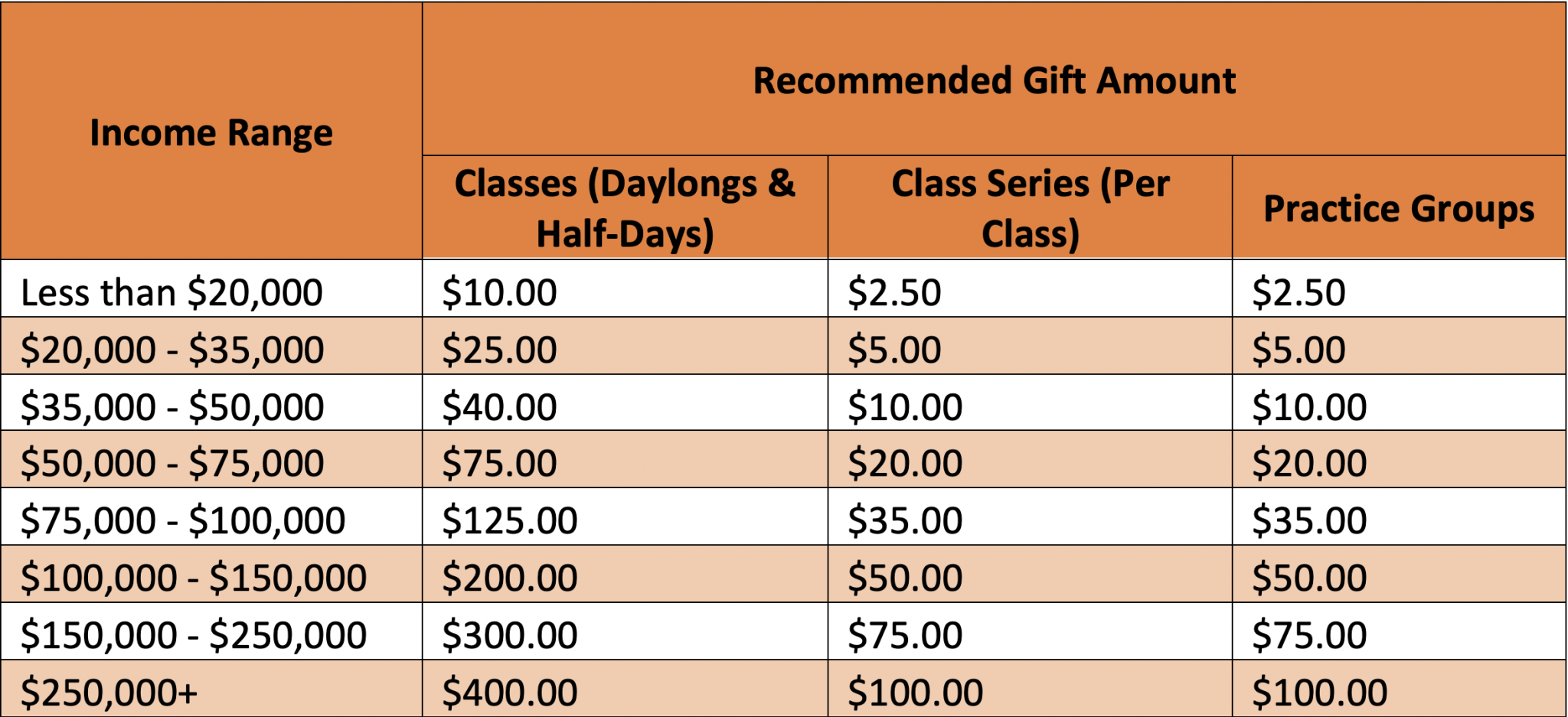
Do I have to give?
No. Our programs are open to everyone, and no one is ever turned away for lack of funds. We invite you to give what you can — but your presence is always welcome, gift or not.
What if I can't afford to give anything right now?
Then please come anyway. Gift economics exists precisely so money is never a barrier. You can give in other ways — your presence, your practice, your volunteer time — or give later, when you're able.
How much should I give?
Whatever reflects your means and feels sustainable. The suggested ranges above are a guide, not a rule.
Is my gift tax-deductible?
Yes. EBMC is a registered 501(c)(3) nonprofit, so your donation is tax-deductible to the extent allowed by law. Our EIN number is 94-3376180.
Where does my gift go?
Directly to sustaining our programs, our teachers, and our community space — keeping the dharma available to all, regardless of financial means.
.png)
.svg)